
In today’s issue of the journal Science two papers describe the discovery of a new gene for ALS (you can read the abstracts here and here). Around 90% of ALS cases are sporadic, i.e. we don’t know what causes them, but for 5-10% of patients the disease runs in their family (known as familial ALS, FALS). Until today, there was only one major causative gene that we knew about, called SOD1, which accounted for 20% of familial cases. Today’s new discovery of the gene FUS (also known as ALS6) accounts for an additional 3-5% of familial cases and was the result of an international collaboration between scientists in Boston, London, and Sydney. This is very exciting for research because the more we know about what causes ALS, the better our chances of finding an effective treatment through better understanding of the pathways involved in motor neuron degeneration.
Here at PatientsLikeMe, we’ve recently upgraded our ALS platform to capture data on familial ALS patients’ known genetic mutations. The goal is to help familial ALS patients find another patient like them, and to enhance understanding of the phenotype of each mutation, e.g. if different types of mutation cause a faster or slower disease progression. Ultimately our aim is to try and establish whether there might be any treatments that have a differential effect on patients with different disease-causing mutations. There are examples of this already known in other diseases; for instance the presence of absence of the Philadelphia chromosome in chronic myelogenous leukemia (CML) predicts whether the patient will respond to the drug Gleevec. Although there is currently only a single effective treatment for ALS (Rilutek), there are a number of trials underway investigating the potential of drugs for patients with specific gene mutations.
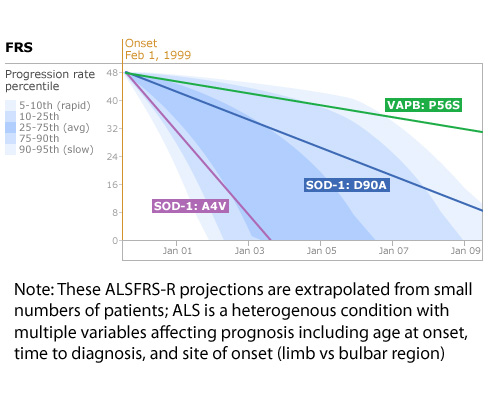
The unique outcome data captured on the PatientsLikeMe platform also allows us to learn more about the nature of the disease for FALS patients with different genetic mutations. In the graph above you can see the average rate of progression for patients with three different FALS mutations; the common and aggressive A4V mutation (sadly average survival is ~18 months), the rarer recessive D90A mutation (much longer average survival of ~13 years), and a very rare and recently identified mutation of VAPB, referred to as ALS8. Collecting genetic data and combining it with high-quality patient-reported outcomes helps a patient to answer the question “Given my status, what is the best outcome I can expect to achieve, and how do I get there?”.
Note: If you have familial ALS and know your genetic mutation status please consider joining our ALS community and sharing your genetic information through your diagnosis history.




hi,
i was on a meeting about genetic als. as rilutek is the only known medecine, and its effect is better when started early. why not start feeding family members 5 years before diagnose age in that family?
comments please…
cheers antti
Dear Antti,
A very good point! There is a group of “people at risk of familial ALS” (PARFALS) that should be studied in more detail. To our knowledge there are only two small studies on this population. The first looked at brain changes of SOD1 D90A mutation patients and found that healthy people *with* the mutation had some subtle, but detectable changes relative to healthy people without the mutation (see Turner MR et al 2005, Distinct cerebral lesions in sporadic and ‘D90A’ SOD1 ALS: studies with [11C]flumazenil PET, Brain 128(6):1323-1329). The second looked at the brains of healthy people carrying the SOD1 mutation was compared to controls; they found that the brains of SOD1 carriers who went on to develop ALS symptoms became more electrically excitable just before the onset of ALS. (see Vucic S et al 2008, Cortical hyperexcitability may precede the onset of familial amyotrophic lateral sclerosis, Brain 131(6):1540-1550).
In the animal studies that are conducted on ALS mice, researchers start giving treatments before the onset of symptoms, so it would certainly be an interesting study. The problem though is one of logistics: most research grants only last 3-5 years and require a statistically significant “critical mass” of participants to be meaningful. If we were to study whether giving PARFALS Riluzole preventatively (as a “prophylactic”) we would need an multicenter 10-20 year study with PARFALS randomized to either get Riluzole or not. You’d probably want to do it in the more aggressive A4V SOD1 mutation patients because that way you could see the difference faster (D90A patients progress too slowly anyway to see a difference).
During the course of Paul’s PhD he met about two dozen FALS patients and their families, including children who are PARFALS. The hope is that there will be a cure by the time they would start expressing symptoms but this is a real threat hanging over many people. To make this type of research a reality will require lobbying and advocacy by informed people such as yourself, we wish you luck and are happy to help in any way we can.
Sincerely,
Paul Wicks & Catherine Brownstein
This month 3/09 in our “Star” Newspaper was a story about a dog who researchers link its malady to human ALS. The findings appeared last month in the “Proceedings of the National Academy of Sciences. The researchers at the University of Missouri College of Veterinary Medicine were exploring a genetic cause for degenerative myelopathy or DM in dogs. I have not heard one word about this break-through about the ALS connection to humans, could you check this breakthrough out? It is to late for my son, Jim he passed last month one year after being diagnosed Feb. 14, 2009 he was 52.
Dear Ms. Reimers,
Thank you so much for your comment!
Degenerative myelopathy (DM) has been documented in certain kinds of dogs (such as German Shepards and Brittany Spaniels) since 1973. However, when the disease began showing up in more and more dog breeds, researchers took notice. In February it was reported that DM affected dogs have a mutation in the SOD1 gene, similar to the ALS-causing mutation sometimes seen in humans. Analysis of DNA samples from 38 DM-affected Pembroke Welsh corgis revealed a SOD1 E40K missense mutation not seen in the 17 related unaffected controls.
The SOD1 mutation discovery is great news for the ALS community, since possible future therapies will be tested on these dogs. There is hope that this dog model of ALS will be better tool for research than the mouse model of ALS; it was recently found that minocycline, which had been reported to slow the disease in SOD1 mice, actually accelerates the disease in humans with ALS (though whether this was due to inappropriate dosing remains under debate).
In other words, the discovery of the SOD1 mutation in canines is a great thing for ALS research, and we look forward to what therapies this discovery may bring!
Sincerely,
Catherine
Catherine Brownstein MPH, PhD
My mother and aunt, though 7 years apart in age were diagnosed with Bulbar ALS within 6 month of each other. Does that sound like something they were exposed to at the same time or could it be that their children were born around the same time. I worry about myself and my siblings and cousins. No genetic link was found in my mothers case. Can I do something to fight off getting it?
My mother and her sister both had ALS They say it is nearly unheard of in the same family and only passed on in birth if patient is pregnant 9 or less years before diagnosis..
My mother always said she thinks it’s an over abundance of no pest strips that attack the muscles of insects.. Why couldn’t they effect a human over the years?.. My mother was a very intelligent person.. I believe this may have merit.. someone should check into it..
my mother was diagnosed with als when i was 15 months old! she survive for 18 years! i have never heard of it being passed on in birth if patient is pregnant 9 or less years before diagnosis! is this true? i am doing research please let me know-thanks!
Dear Emily and Deanna,
I have not heard of ALS not being passed on at birth if patient is pregnant 9 or less years before diagnosis. That seems highly unlikely.
It isn’t known why ALS strikes some people and not others, though genetic mutations can cause the disease (these mutations can be inherited from our parents or just occur randomly). Scientists have looked at environmental exposures as a possible cause of ALS, too, but no relationship has been proven.
At PatientsLikeMe we are working to understand as much as we can about ALS, including why some people are able to live for 18 years or longer with the disease. We ask for your help- please share all you can on PatientsLikeMe and learn from each other!
Sincerely,
Catherine
Catherine Brownstein MPH, PhD
My husbands mother and aunt both died from ALS many years ago. His mother, who was younger (early 50s), died first and then his aunt several years after that (mid 50s). His brother (46 – 2 years older than my husband) has recently been diagnosed with ALS. Even though they didn’t find any other cases in their family tree does this suggest a genetic link? Does that mean my husband and kids have a 50/50 chance of getting it? Are there any preventative things we can be doing? He takes Vitamin E and he was thinking about starting to take CoQ10.
Dear Denise,
Thank you for your post. It sounds like there may be a genetic component; I would recommend seeing a Genetic Counselor. He/she will be able to take a detailed history and explain all of your options.
Best wishes,
Catherine
Catherine Brownstein MPH, PhD
My grandmother died from ALS several years ago and I was Dx with MS last year. Is there any research indicating a connection between diseases in families, such as ALS and MS?
Dear Jaimie,
Sorry to hear about your grandmother’s passing. So far as I know there is no known overlap between ALS and MS, so it’s most probably a coincidence. Most cases of ALS (95%) are not inherited, i.e. they appear out of the blue and only affect one person in the family. There is some evidence to suggest that MS has some inherited component but it’s not a very strong association. I would certainly anticipate ALS and MS to have quite different mechanisms, causes, and genes.
Best wishes
Paul Wicks, PhD
Is there any ongoing research in the FALS area being conducted on family members that have tested positive for the SOD1 -A4V– but are not symptomatic? Perhaps if not one should be started ?? Within the last 3 years my father and brother have died within a year of diagnosis, now my sister is 7 months into this beast of a disease. Seems as if opportunity for study once you have started the journey is fairly short– due to methods and also time devoted to hospital admission. Our families PALS are just so weary that adding anything as taxing as even a clinic visit takes so much out of them that study becomes impossible. as well as just being seem at the clinic every 2 or 3 months just begins to scratch the surface of the progression of symptoms. I know patients like me is a small part of patients info but why isn’t someone researching and asking questions on the yahoo groups that are active in ALS the only place some go to get info on progression! ALSTDI is about the same also, and the nurse on there is so full of info that she is study subject herself— also the link to dogs and horses in the neuromuscular are needs exploration. My theory– what turns it on —insect (mosquito or tick) bite which flips on a viral switch.
Dear Nimrobs,
Sorry to hear of your family’s situation. Yes this group of individuals has a lot of potential for research, but because it’s so difficult to gather a group of them sufficient to do research, few projects happen. There is an ongoing research study at Emory called pre-FALS (http://www.als-research.org/research/pre_fals.html) which might be of interest.
We would also invite as many FALS as possible to join PatientsLikeMe and enter as much data as they can to contribute to our better understanding of how each of the different SOD1 mutations affects PALS.
Best wishes
Paul
Hi my dad and and his uncle had als. Now I developed sjgorens does this mean I will get als?